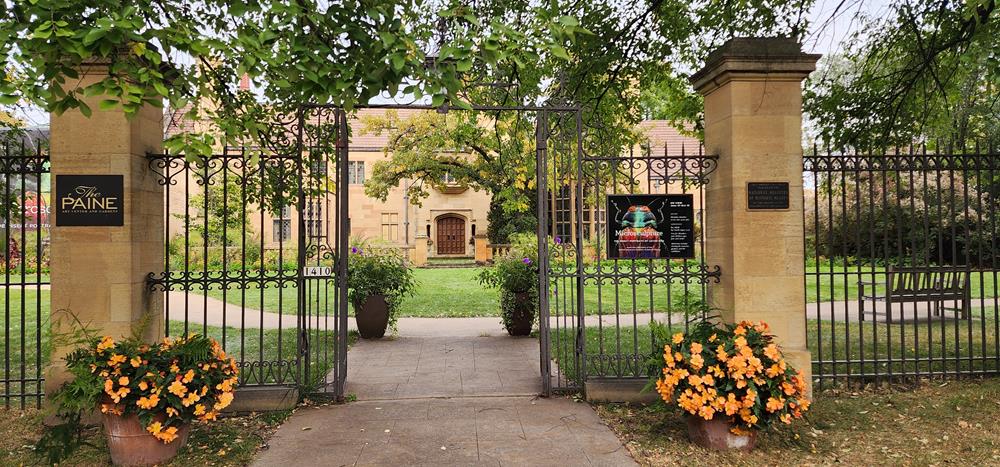
There are places where you expect to find an English country estate. The middle of Oshkosh probably isn’t the first setting that comes to mind. Paine Art Center & Gardens is a beautiful museum, garden, house, and grounds that will definitely serve as a nice stop on any road trip to Oshkosh.
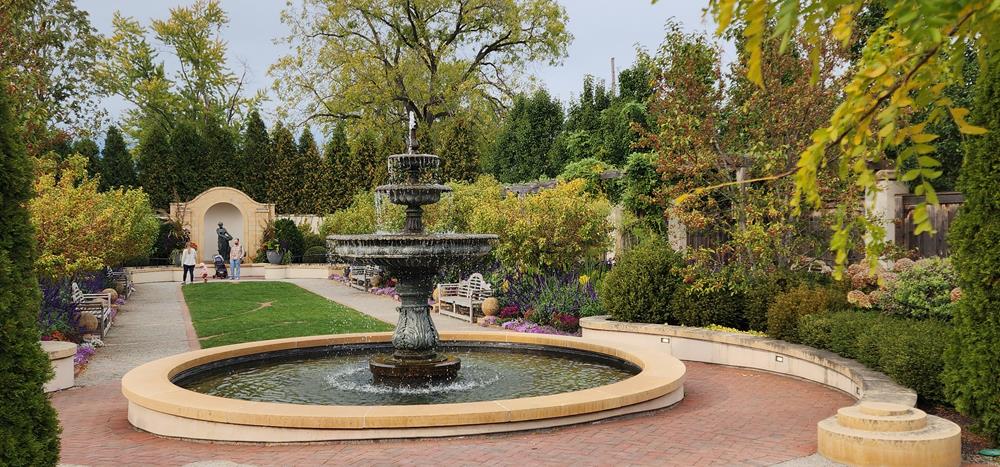
Then the limestone walls and tall chimneys of the Paine Art Center & Gardens come into view along Algoma Boulevard, also Highway 21. Pass through the gates and the city seems to recede. Garden paths branch past fountains, formal plantings and quiet corners, while the mansion rises over the grounds like a home with centuries of stories behind it.
And yet, it only looks centuries old.
First going up on the north side of Oshkosh in the late 1920s, the Paine was designed to suggest an English estate that had evolved over several architectural eras. It’s part historic house, part art museum and part botanical garden—and each part is interesting enough to justify the stop on its own.
A magnificent house its owners never lived in
The story begins with two families deeply connected to Wisconsin industry. Nathan Paine became president of the Paine Lumber Company, which operated a sprawling mill complex along the Fox River and employed more than 2,000 people by the mid-1920s. His wife, Jessie Kimberly Paine, was the daughter of John A. Kimberly, one of the founders of Kimberly-Clark.
Nathan and Jessie traveled widely and shared an appreciation for art, architecture and landscape design. In 1925, they commissioned New York architect Bryant Fleming to create a Tudor Revival country estate reflecting their English ancestry. Their intention went well beyond building a private showplace. From the start, they envisioned the estate eventually opening to the public as a center for art, culture and education.
Construction began in 1927. The exterior was essentially complete by 1930, but the Great Depression hurt the Paine Lumber Company and brought the remaining work to a halt in 1932. For more than a decade, the enormous house sat unfinished.
The Paines revived their plans in the 1940s, this time focusing on establishing the property as a museum. Nathan died in 1947; Jessie then oversaw the final work needed to open the estate to the public in 1948. In one of the most fascinating twists in the story, neither Nathan nor Jessie ever lived in the mansion they created.
That makes the Paine different from many historic-house museums. Visitors are not simply touring the former residence of a wealthy family. They are experiencing a place deliberately planned as a public gift.
Old-world atmosphere, Wisconsin materials
Architect Bryant Fleming varied the arches, windows, columns, doors and chimney stacks so the mansion would appear to have grown over roughly three centuries of changing English styles. Tudor, Jacobean, Georgian, Regency and other influences reveal themselves from room to room.
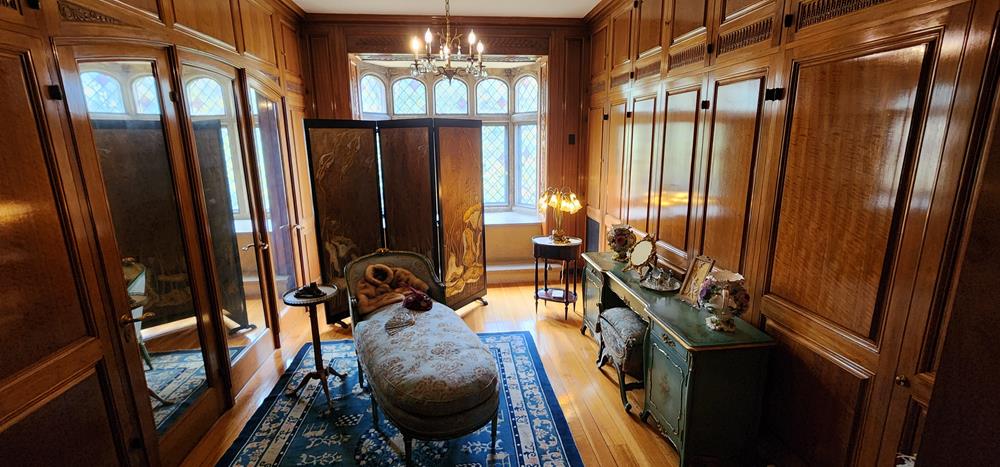
Nathan Paine, whose life was rooted in the lumber business, paid particular attention to materials and craftsmanship. Oak and walnut woodwork fills the interior. Much of it was left unvarnished to showcase the wood itself. Most of the stonework is Kasota limestone from Minnesota; when polished indoors, portions of it take on a marble-like sheen.
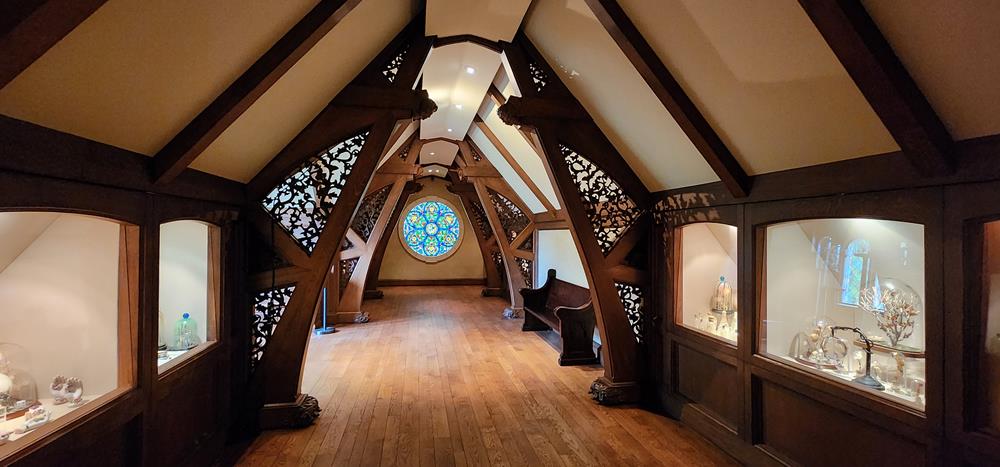
Look upward as well as around. Carved plaster ceilings, patterned leaded-glass windows, heavy beams and decorative details help complete the illusion of a much older house. The 18-foot ceilings and broad limestone fireplace in the Great Hall make a particularly memorable first impression.
Beneath all that old-world style is a surprisingly modern skeleton. The mansion was built around steel and concrete to make it fireproof—a priority for Nathan after major fires had repeatedly struck Oshkosh and had also destroyed one of his own homes.
The building itself is therefore one of the Paine’s finest exhibits. Even visitors who do not ordinarily seek out architecture will find plenty to study.
Art inside—and throughout the estate
The Paine’s collection includes more than 1,000 paintings, sculptures, furnishings and decorative objects. Nathan and Jessie acquired much of it, with particular strengths in French Barbizon and American landscape painting from the late 19th and early 20th centuries.
Art is displayed throughout the period rooms, so touring the mansion feels different from walking through a conventional white-walled museum. Paintings, carved furniture, textiles, sculpture and architectural details work together to create a complete setting.
Dedicated gallery spaces host changing exhibitions during the year. That gives travelers a good reason to return: the estate remains familiar, but the featured artwork may be entirely different from one visit to the next. The second-floor Helen Farnsworth Mears Gallery also recognizes the accomplished sculptor who was born in Oshkosh and holds examples of her work.
Outside, sculpture becomes part of the landscape. Pieces placed among flowers, hedges and garden paths blur the line between art gallery and botanical garden.
The gardens are a series of outdoor rooms
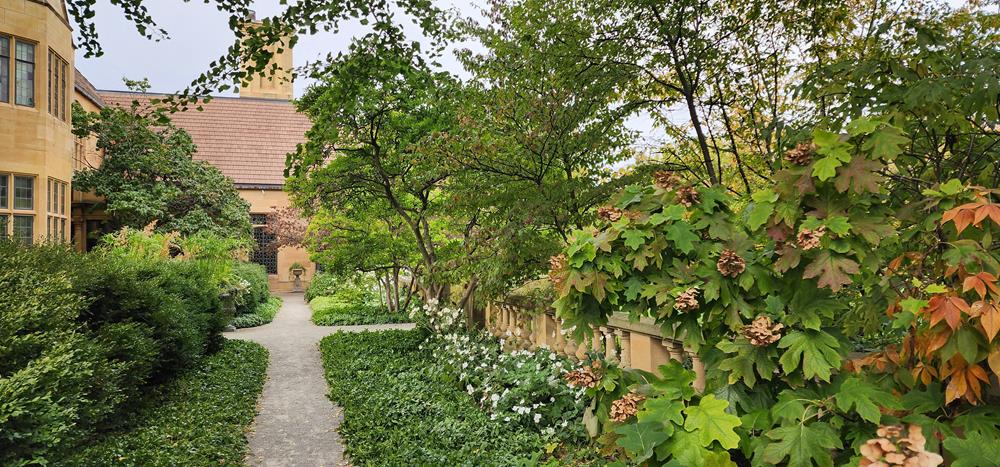
The Paines did not plan the grounds as an afterthought. The Algoma Boulevard property had once been a family cow pasture dotted with mature oak trees. Nathan wanted the house to appear carved from the woods, so he oversaw the planting of approximately 500 additional trees—mostly evergreens—in rings around the property.
When the estate opened in 1948, it was known as the Paine Art Center and Arboretum. As the landscape matured and changed, the grounds developed into nearly four acres of interconnected garden “rooms.” Wandering from one to another is a major part of the experience.
The Great Lawn provides one of the best full views of the mansion. The White Garden, planted with white, silver and gray foliage, follows the tradition of a Victorian moon garden designed to remain luminous into the evening. The enclosed Rose Garden surrounds a reflecting pool with roses and perennials, while the Contemporary Garden mixes grasses, masses of textured plants and outdoor sculpture.
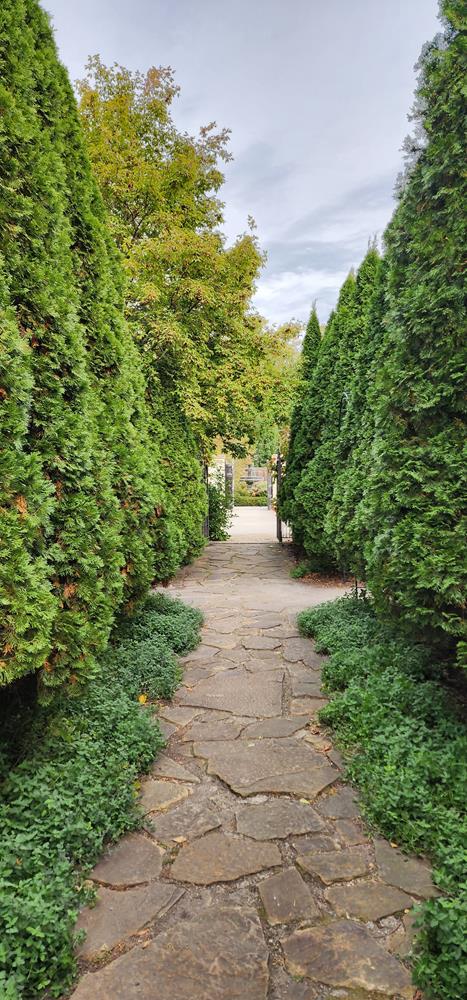
Families should seek out the Children’s Garden, with its cabin, circular stage, picnic tables and musical mushroom-shaped marimbas. The Herb Garden near the Carriage House brings together culinary, medicinal and edible plants.
The most formal setting lies at the eastern edge of the property. Created in 2017, the sunken Formal Garden includes fountains, sculpture, pergolas, stonework and symmetrical planting beds. Its displays are designed to change through the growing season.
Do not treat the gardens as a quick lap around the house. Benches, Adirondack chairs, patios and tucked-away viewpoints invite you to slow down. The estate rewards both the wide establishing shot and the close-up: the mansion reflected in water, a flower framed against limestone or a sculpture half-discovered through the foliage.
A different Paine in every season
There really is no single “best” time to visit. The better question is which version of the Paine you want to see.
Spring: tulips, bulbs and flowering trees
Spring brings one of the estate’s most anticipated displays. Thousands of tulips fill the Formal Garden, bulbs brighten the Great Lawn and magnolias bloom around the White Garden. The contrast between fresh flowers and the weathered-looking limestone mansion is especially photogenic. Bloom times depend on Wisconsin weather, so check the Paine’s website or social channels when timing a flower-focused trip.
Summer: the gardens at full strength
By summer, the estate feels lush and layered. Annuals take over from spring bulbs, roses and perennials supply color, and grasses add height and movement to the Contemporary Garden. Summer often brings a major featured art exhibition as well, making this the most complete indoor-and-outdoor version of a Paine visit.
Fall: texture, late color and quieter walks
Autumn shifts the emphasis from bright summer color to foliage, ornamental grasses, seed heads and frost-hardy plantings. The Formal Garden is designed to carry its display into fall, while mature trees add color above the grounds. Cooler temperatures and a somewhat quieter atmosphere can make this an especially pleasant time to explore.
Exhibition changeovers can occasionally close part or all of the mansion for a limited period, so fall travelers should confirm exactly what is open before arriving.
Holiday season and winter: Nutcracker in the Castle
Beginning around late November, the focus moves indoors for Nutcracker in the Castle, the Paine’s signature annual holiday event. More than 20 rooms and spaces become scenes from the Nutcracker story, filled with elaborate decorations and dozens of Christmas trees. Depending on the date and ticket selected, visitors may find self-guided daytime tours, evening candlelight experiences or guided presentations with music, acting and dance.
The gardens are naturally more subdued in winter, but the bare landscape exposes architectural lines and views hidden during summer. Inside, the mansion is at its most theatrical. Reservations can be required or strongly recommended for holiday experiences, particularly on popular dates.
Make it part of an Oshkosh day trip
The Paine can easily anchor a half-day or full day in Oshkosh. Allow about two hours to tour the mansion and gardens without rushing—roughly an hour for each.
The Oshkosh Public Museum is directly nearby on Algoma Boulevard, making the two museums an easy pairing. Its exhibits explore the history of Oshkosh and the Lake Winnebago region inside another impressive historic home.
For a meal or craft beer afterward, Fox River Brewing Company is only a few minutes away at its waterfront Oshkosh location. Its patio, dockside setting and views of the Fox River make a relaxed counterpoint to the formality of the Paine.
You can also continue toward downtown for the Oshkosh Riverwalk and The Grand Oshkosh, or head toward Lake Winnebago and Menominee Park. Aviation enthusiasts can make a longer day of it by adding the EAA Aviation Museum on the city’s south side.
For Highway 21 travelers, the Paine works particularly well as the refined ending to a route filled with central Wisconsin scenery, small towns and outdoor stops. One moment you are finishing a cross-state highway near U.S. 45; a few minutes later, you are walking through an English-inspired estate that feels far removed from the road outside.
Why the Paine belongs on your Wisconsin road-trip list
The Paine Art Center & Gardens succeeds because none of its parts feels secondary. The house is not merely a container for the art. The gardens are not simply decoration around the house. Architecture, paintings, furnishings, sculpture and landscape all contribute to the same experience.
It also rewards repeat visits. Come in spring for tulips and flowering trees, in summer for the gardens at their fullest, in fall for texture and changing color, or during the holidays when the “castle” becomes a Nutcracker storybook.
Nathan and Jessie Paine never moved into their remarkable house. In a sense, that left it for everyone else—and nearly eight decades after it opened to the public, it remains one of Oshkosh’s most beautiful and distinctive places to explore.
Quick facts: Paine Art Center & Gardens
Address: 1410 Algoma Boulevard, Oshkosh, WI 54901
Location: A short drive east of Wisconsin Highway 21’s eastern terminus at U.S. 45
Top features: Tudor Revival mansion, historic interiors, changing art exhibitions, outdoor sculpture and nearly four acres of seasonal gardens
Time to allow: Approximately two hours for both mansion and gardens
Parking: On-site lots are available along Algoma Boulevard and Congress Avenue, with accessible spaces; street parking is also available
Accessibility: The mansion has an elevator, although a portion of the second floor has limited wheelchair access; the Carriage House, Conservatory and gardens are accessible
Photography: Amateur photography is generally permitted with paid admission, although rules may vary for temporary exhibitions; professional sessions require advance permission
Pets: Only trained service animals are permitted, including in the gardens
Hours and admission: Change with the season and special events; reservations are recommended and may be required for certain programs
Paine Art Center & Gardens Address:
1440 Algoma Blvd (Highway 21)
Oshkosh, WI 54901
(920) 235-6903
Website


Back to StateTrunkTour.com